
Is Your Kid's Backpack Wrecking Their Spine? What Portland Parents Should Know This Fall
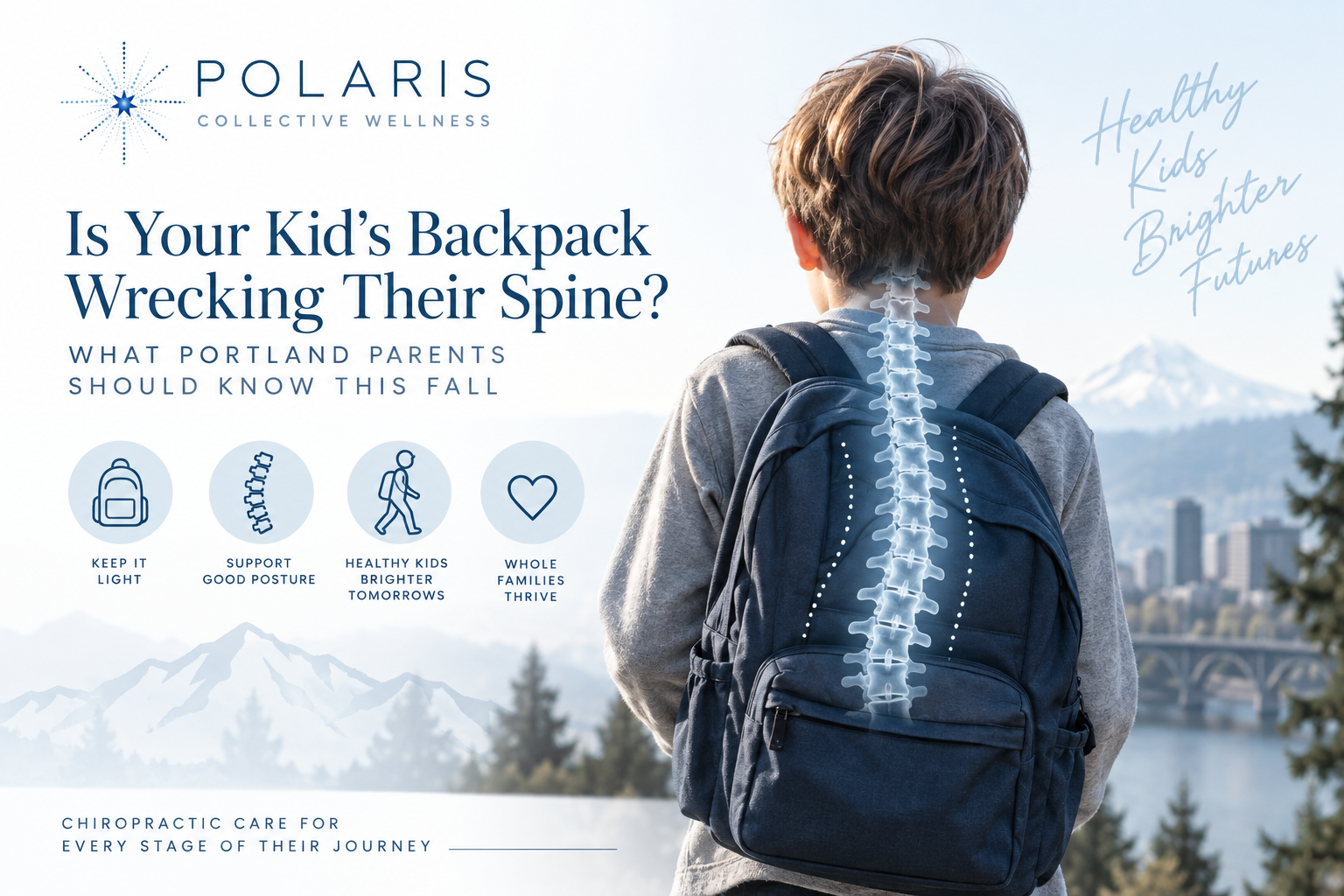
Fall is here, and with it comes the familiar ritual: new shoes, school supplies, and a backpack that starts the year nearly empty and somehow ends up stuffed with textbooks, a Chromebook, a water bottle, a lunch bag, and whatever else accumulates in a kid's world. I see it every year in my practice — and I see the consequences of it, too.
If your child has been complaining about back or neck pain, or you've noticed they're walking a little funny lately, the backpack might be doing more damage than you think.
The Weight Problem Is Real
Here's the guideline I use with every family I talk to: a child's backpack should weigh no more than 10 to 15 percent of their body weight. That means a 70-pound second grader should be carrying no more than 7 to 10 pounds. A 100-pound middle schooler? No more than 15 pounds.
Now think about what's actually in that bag.
Heavy loads carried on the back — especially when worn low or over one shoulder — force the spine to compensate. The body shifts forward, the head juts out, the shoulders round, and the lumbar curve flattens or exaggerates depending on how they're bracing. Over time, those compensations don't just stay in the backpack moment. They start to become the default posture. And in a growing child, that matters enormously.
Portland Makes This Worse
I love this city, but let's be honest: Portland is not a backpack-friendly environment in the fall. Wet sidewalks, hills, and kids who are already bundled up and moving carefully to avoid slipping — add a heavy pack and you've got a recipe for muscular bracing, awkward gait patterns, and real strain on young spines that are still developing.
And here's something I hear constantly from the kids I see: the backpack never comes off. Not because they don't want to — but because lockers either aren't available at their school, aren't conveniently located between classes, or just aren't realistic to use with back-to-back schedules. So that heavy bag goes everywhere with them, all day long. That daily load adds up fast.
Warning Signs to Watch For
Kids don't always tell you their back hurts. Sometimes they complain about headaches. Sometimes they just seem tired or cranky after school. Sometimes you notice something looks a little off but can't quite name it.
Here's what I'd encourage you to actually look for:
- One shoulder sitting higher than the other — this is a common and often overlooked sign
- Leaning forward when they walk, especially with the pack on
- Complaints of back, neck, or shoulder pain — even if they seem minor
- Headaches, especially at the base of the skull, that appear regularly on school days
- Posture that's changed since the school year started — rounded shoulders, forward head posture
- Fatigue or reluctance to walk places they used to be fine with
None of these symptoms on their own are necessarily alarming, but together — or consistently — they're worth paying attention to.
What Chiropractic Can Do:
Pediatric chiropractic care is something I'm deeply passionate about. Kids respond extraordinarily well to chiropractic adjustments, and the goal with children is always gentle, specific, and age-appropriate care. We're not doing the same thing to a 9-year-old that we'd do to a 45-year-old.
What I'm looking for in a pediatric spinal check is whether the joints of the spine are moving the way they should — and whether there are areas of restriction or misalignment (what we call subluxations) that are creating tension in the nervous system or affecting posture. When kids carry heavy loads repeatedly, those restrictions can develop gradually and quietly. A check-in before they become a bigger problem is always easier than addressing them after months of compensation.
Beyond the adjustment itself, I'll also talk with you and your child about practical things: how to pack the bag smarter, how to wear it correctly (both straps, higher on the back, close to the body), and whether the bag itself might need to change. And if lockers aren't a realistic option — which honestly, for a lot of kids they're not — we'll talk through what else can help lighten the load.
I hold certifications in pediatric chiropractic (CACCP) specifically because I wanted to be equipped to care for kids at every stage — from newborns to teenagers. This is a population I take seriously, and the back-to-school season is one of the most important times to check in.
A Simple Ask
If your child has started school with a heavy pack and you haven't had their spine checked in a while — or ever — I'd encourage you to come in. A pediatric spinal evaluation is straightforward, non-invasive, and gives you a clear picture of how their spine is holding up.
We're located at 4412 SW Barbur Blvd, Suite 220, Portland OR 97239, and we see kids of all ages at Polaris Collective Wellness.
Call us at (503) 676-6728 to book a pediatric spinal check this fall. Your kid's spine will thank you — even if they won't.
— Dr. Raleigh Warren, DC, CACCP, CFMP
Polaris Collective Wellness | polariscw.com